Introduction
Organizations today face growing complexity. Teams manage multiple projects, data flows continuously, and leaders are expected to make decisions faster than ever before. In such an environment, efficiency becomes a strategic advantage. Management by Exception is an operational approach that identifies and prioritizes elements deviating from what we would consider normal conditions.
Rather than reviewing every minor detail, this method encourages leaders to focus only on significant variances that require intervention. It reduces unnecessary oversight and allows managers to concentrate on strategic decisions rather than routine tasks.
In this guide, we explore the meaning of management by exception, its practical applications, benefits, limitations, and how it connects to modern digital workflows and performance monitoring systems.
What Is Management by Exception?
Management by Exception is a leadership strategy in which managers intervene only when actual performance deviates significantly from established standards.
Instead of constant supervision, the approach relies on predefined benchmarks. When operations remain within acceptable ranges, no action is required. When deviations occur, managers step in.
The concept originated in accounting and financial control systems, where variance analysis is essential. Over time, it evolved into a broader operational philosophy.
This method is rooted in efficiency. Leaders conserve time and cognitive resources by focusing on meaningful exceptions rather than routine activities.
Core Principles Behind the Approach
The foundation of management by exception lies in structured monitoring and accountability.
Key principles include:
- Establishing clear performance standards
- Monitoring results regularly
- Identifying deviations beyond acceptable thresholds
- Taking corrective action only when necessary
| Principle | Purpose |
| Performance Benchmarks | Define expected outcomes |
| Variance Monitoring | Detect abnormalities |
| Escalation Protocol | Trigger managerial review |
| Corrective Action | Restore alignment |
These principles ensure structured oversight without micromanagement.
How Management by Exception Works in Practice
In practical terms, the approach follows a predictable process.First, measurable targets are defined. These could include revenue goals, production quotas, quality standards, or operational KPIs.
Second, systems monitor actual performance. This monitoring may be automated through dashboards or manual through reporting cycles.Third, if performance remains within acceptable limits, managers do not intervene. If results exceed or fall below thresholds, managerial action is triggered.
This structured escalation prevents unnecessary interference while ensuring accountability.
Applications in Business Operations
Management by exception is commonly applied in:
- Financial auditing
- Manufacturing quality control
- Project management
- Supply chain monitoring
- Sales performance tracking
For example, a manufacturing company might define acceptable defect rates. If defects exceed the threshold, managers investigate.
In project management, deadlines are monitored. If timelines slip beyond acceptable margins, leadership steps in.This targeted intervention improves efficiency without overburdening managers.
Benefits of Management by Exception
The advantages of this approach are substantial.
It allows managers to:
- Focus on strategic initiatives
- Reduce unnecessary supervision
- Improve productivity
- Empower employees
- Respond quickly to major issues
By avoiding constant oversight, leaders free up time for innovation and long-term planning.
Employees also benefit from increased autonomy. Routine tasks proceed without interruption unless significant problems arise.
Potential Drawbacks and Risks
Despite its benefits, management by exception is not without limitations.
Possible challenges include:
- Delayed detection of minor issues
- Overreliance on automated monitoring
- Reduced communication in some teams
- Risk of disengagement if thresholds are poorly defined
The approach works best when performance metrics are accurate and aligned with organizational goals.
Balanced implementation is key.
Comparing Traditional Management to Management by Exception
Traditional management often involves constant review and direct supervision. By contrast, management by exception prioritizes selective intervention.
| Traditional Management | Management by Exception |
| Continuous oversight | Conditional oversight |
| Detailed reporting review | Variance-focused review |
| Higher managerial workload | Reduced workload |
| Lower autonomy | Increased autonomy |
Modern organizations increasingly adopt data-driven systems that align with exception-based monitoring.
Role in Modern Digital Workflows
Digital transformation has enhanced the viability of management by exception.
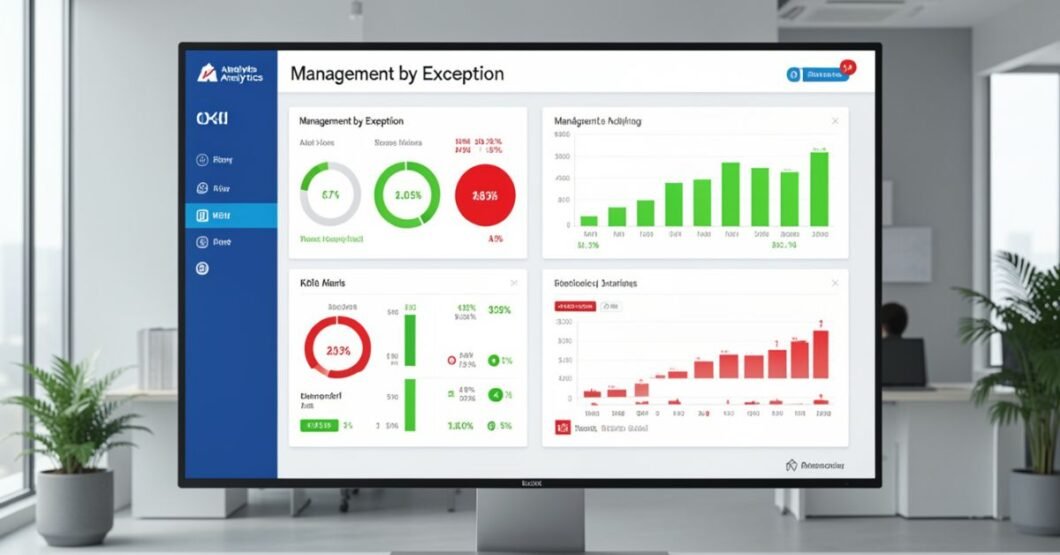
Advanced software systems provide real-time dashboards, automated alerts, and predictive analytics. These tools enable instant identification of anomalies.
For example:
- Automated accounting systems flag irregular transactions.
- CRM dashboards highlight underperforming campaigns.
- HR systems detect compliance irregularities.
Technology enhances the precision of exception-based oversight.
Management by Exception in Agile and DevOps
Agile methodologies emphasize flexibility and rapid iteration. Management by exception complements this by minimizing unnecessary interference in daily workflows.
In DevOps environments, monitoring systems detect:
- Deployment failures
- Security vulnerabilities
- Performance degradation
Managers intervene only when exceptions occur, allowing development teams to operate autonomously.
This approach improves speed while maintaining control.
The Future of Management by Exception
As artificial intelligence continues evolving, management by exception will likely integrate predictive capabilities.
Future systems may:
- Forecast potential deviations before they occur
- Provide automated corrective suggestions
- Use AI-driven risk scoring
Rather than reacting to deviations, organizations may proactively prevent them.This evolution aligns with modern performance management strategies.
FAQs
What is Management by Exception?
It is a leadership approach where managers intervene only when performance deviates from predefined standards.
Why is it effective?
It saves time and focuses attention on significant issues.
Is it suitable for all organizations?
It works best in data-driven environments with clear performance metrics.
What industries use it most?
Finance, manufacturing, project management, and IT operations.
Does it reduce employee oversight?
Yes, it increases autonomy when performance remains within acceptable limits.
Conclusion
Management by exception represents a strategic shift from constant supervision to targeted intervention. By focusing only on significant deviations, organizations conserve managerial resources and improve operational efficiency.
In modern digital environments, automated monitoring systems enhance the effectiveness of this approach. When implemented carefully, it promotes accountability, autonomy, and strategic clarity.